
B2B keyword research is the process of connecting search demand to a specific buyer, problem and commercial offer. The output should be a map of pages and decisions. A spreadsheet of thousands of phrases is only raw material.
Start with what you want to sell. A software development company may attract many visitors for a programming tutorial, but those visitors may be developers seeking an answer rather than buyers looking for a delivery partner. Both audiences can matter; they should not be mistaken for each other.
Define the buyer before choosing the seed keywords
Write down the role, company type, problem and buying trigger. For example: a marketing lead at a B2B SaaS company whose organic traffic grows but whose demo requests do not. This is an illustrative persona, not a claim about every SaaS company.
Collect phrases from sales calls, support tickets and product descriptions. Ask what the buyer calls the problem before they know your category. Keep these source notes beside the keyword so the business context survives the research process.
Research demand separately for the US and UK
Country-level estimates help reveal differences in phrasing and opportunity. In our Ahrefs research dated 19 September 2026, “saas seo consultant” showed an estimated 800 monthly searches in the US and 300 in the UK. Those are searches, not available customers or a forecast of this website's traffic.
Use volume to understand scale, difficulty to prompt a closer look at competition, and the actual search results to assess intent. Missing data is unknown, not zero. A low difficulty score does not tell you whether a new website has the authority, evidence or offer to compete.
Group by the decision, not by shared words
| Example query | Likely decision | Useful destination |
|---|---|---|
| What is B2B SEO? | Understand the channel | Educational guide |
| Technical SEO for SaaS | Diagnose implementation risks | Practical checklist with examples |
| SaaS SEO consultant | Evaluate a provider | Service page with scope and proof |
| How to choose an SEO consultant | Compare candidates | Evaluation framework |
Search results can show mixed intent. Inspect the leading pages before choosing a format. If the same URLs repeatedly rank for two phrases, investigate whether one page should answer both. Do not create a new page for every wording variation.
Score opportunities with business fit first
Use a simple editorial score: buyer fit from 0 to 3, connection to your offer from 0 to 3, available evidence from 0 to 3 and implementation effort from 1 to 3. Review the score alongside demand and search-result competition. This is a prioritisation aid, not a ranking model.
A topic with modest volume and strong evidence may deserve attention before a broad acronym definition. For instance, a narrow integration question can be commercially useful if your firm delivers that integration and can show a relevant project.
Record why a topic was rejected as well. Jobs, training, free software downloads and unrelated consumer searches can look attractive in a volume-sorted export but do little for a consulting pipeline.
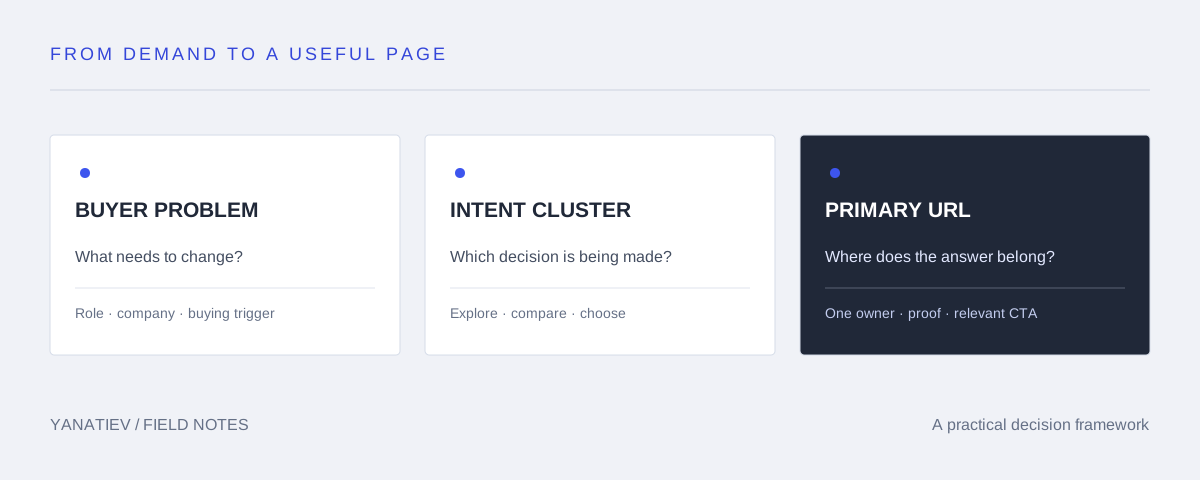
Assign one primary URL to every cluster
For each selected topic, record its primary keyword, supporting phrases, intent, existing or proposed URL, evidence owner and contextual call to action. Label whether the work is a new page, an existing page to preserve or a future revision requiring review.
Keep the broader consulting page as the owner of broad consulting intent. A specialised SaaS page can address product-led questions and buyer fit; an IT services page can address delivery capabilities and project selection. That distinction must exist in the content, not just the title.
Connect the map to the next decision
A discovery guide can point to a diagnostic checklist. The checklist can point to a service with a clear scope. A provider-selection article can link to a case study and a contact page. These links should help a person continue their task; they are not an excuse to repeat the same anchor phrase in every paragraph.
Use the technical SaaS SEO checklist as an example of an evaluation resource and the SaaS consulting page as its commercial destination.
Review after publication
Watch which queries lead to each page, whether the intended URL appears and whether enquiries match your target buyer. If two pages compete for the same intent, first examine their purpose and internal links. Consolidation may help, but do not redirect a useful page simply because two URLs share a word.
Revisit the map monthly during the first publishing cycle. Give pages time to be discovered, and distinguish a lack of impressions from a weak click-through rate or a poor conversion path. Each problem requires a different response.
FROM RESEARCH TO A ROADMAP
Build around the services you want to grow.
Explore SEO for IT companies or SaaS SEO consulting.
Research note
The country estimates cited above come from Ahrefs Keywords Explorer, retrieved 19 September 2026. Search volume is modelled and can change. The scoring method and examples are editorial planning tools.