
SEO improves discovery in search engines. AEO focuses on answering questions clearly. GEO describes work aimed at visibility in generative answers. The boundaries overlap, and the terminology is not a set of official ranking categories. For a B2B team, the useful question is which buyer problem a page answers, what supports that answer and how a reader can act on it.
Consider a security software company. A buyer may first search for a compliance problem, later compare implementation approaches, and finally ask a colleague or an AI assistant for vendors. Publishing three versions of the same introduction under different acronyms does little to help that journey.
What changes between SEO, AEO and GEO?
| Lens | Practical focus | Evidence to review |
|---|---|---|
| SEO | Useful pages that search engines can discover and index | Relevant impressions, clicks and landing-page enquiries |
| AEO | Clear, self-contained answers to specific questions | Whether the page answers the question accurately and completely |
| GEO | How a brand and its pages appear in generated answers | Recorded mentions, citations and accuracy across a defined question sample |
These are working definitions, not three isolated channels. A citation in an AI response is different from a search click. A brand mention without a source link is different again. Keep those observations separate in reporting.
Start with the question your buyer needs answered
Choose a real question from a sales conversation, support thread or search query. Identify the decision behind it. “What is a security questionnaire?” needs a definition. “How do we reduce security questionnaire turnaround?” needs a workflow and trade-offs. “Which solution fits a small security team?” needs evaluation criteria and evidence.
Open with a direct answer, then explain conditions and exceptions. Use headings that describe the next question. Include an example that your team can defend. If you have no original evidence for a claim, cite a reliable source or narrow the claim rather than making it sound more certain.
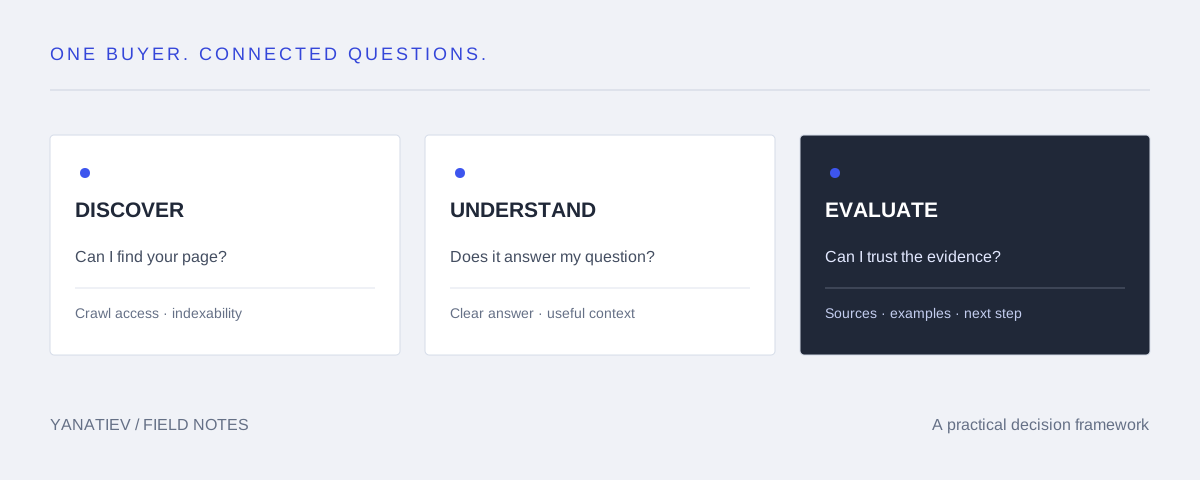
Keep the technical requirements concrete
Google's guidance says pages must be indexed and eligible for a search snippet to appear as supporting links in its AI features. It also says no special AI markup is required. That makes crawl access, indexability, internal links and visible text a sensible starting point. Check the current controls in the relevant webmaster account when preparing a public launch.
Do not treat a new text file or a schema label as a substitute for those foundations. Structured data should describe what a visitor can actually see. Keep the important explanation in HTML; use diagrams to support it, not to hide the only copy of an answer inside an image.
Build evidence that is worth referencing
For a B2B service firm, a useful proof asset might be a clearly scoped case study, a sample decision matrix or an explanation of a recurring implementation failure. For a software product, it might be a documented workflow with screenshots and known limitations. Specificity helps a buyer assess fit even when they never arrive through an AI answer.
Our Uptech case study provides historical project context. It should not be read as evidence that the same traffic result will follow from another company's content plan. Keep the distinction between an observed result and a proposed method visible.
Measure three different outcomes
- Discovery: relevant non-branded queries, indexed priority pages and organic visits.
- AI visibility: mentions and citations in a documented, repeatable sample of questions.
- Commercial response: accepted enquiries, qualified conversations and opportunities, with attribution limitations recorded.
A useful dashboard does not add all three into a single score. More AI mentions may not create more clicks, and more visits may not create more qualified enquiries. Investigate the page, audience and offer before deciding what to publish next.
A practical first-month sequence
First, choose the services and buyers that matter. Next, map their questions to your existing pages and find the gaps. Check technical access on the pages you intend to improve. Then publish one well-supported answer and connect it to a relevant service and case study. Record a baseline before evaluating the result.
Use the buyer-intent keyword research guide to choose the questions, then the AI visibility audit method to measure a defined sample.
Frequently asked questions
Does GEO replace SEO?
No. Technical access and useful content still matter. GEO adds questions about generated answers and source selection; it does not remove the need for a sound website.
Does a clear answer guarantee a citation?
No. Clarity helps people use the page, but platforms choose their own sources and answers vary by context and time.
PUT THE IDEAS TO WORK
Connect your expertise to a useful content plan.
Explore B2B content strategy consulting, or use the existing GEO & AEO audit to establish a visibility baseline.
Sources and scope
Google Search Central: AI features and your website. Checked 19 September 2026. The prioritisation framework in this article is an editorial recommendation, not a platform guarantee.