
A SaaS SEO budget should include strategy, expert input, content production, development and measurement. The right amount depends on your starting point and the work you can execute. Comparing retainers without comparing responsibilities can make an apparently cheaper proposal more expensive in practice.
This guide provides a planning method. It does not publish Yanatiev consulting prices, market-average rates or a promised return. The numeric example below is deliberately hypothetical so you can replace the assumptions with your own figures.
Define the first phase before assigning a monthly number
Start with the constraint. If important pages are not indexable, a larger writing budget will not solve the immediate problem. If the product positioning is unclear, keyword research needs input from product marketing and sales. If your developers are fully committed, a technical roadmap needs a realistic delivery window.
List the first phase's deliverables and their dependencies. A focused phase might include a buyer-intent map, review of a few priority page templates, two content briefs and measurement setup. The exact scope should follow evidence from your website.
Separate fees from internal capacity
| Budget line | What it covers | Often missed |
|---|---|---|
| Strategy and research | Analysis, prioritisation and briefs | Product and sales interviews |
| Content | Writing, editing and visuals | Expert review and factual evidence |
| Development | Templates, technical fixes and QA | Release coordination and regressions |
| Measurement | Source tracking and reporting | Sales qualification and attribution gaps |
| Distribution | Relevant outreach and reuse | Time to create something worth sharing |
Ask each provider which lines are included. If your team supplies writing or development, assign an internal owner and estimate the available hours. Unbudgeted dependencies are a common reason a strategy remains a document.
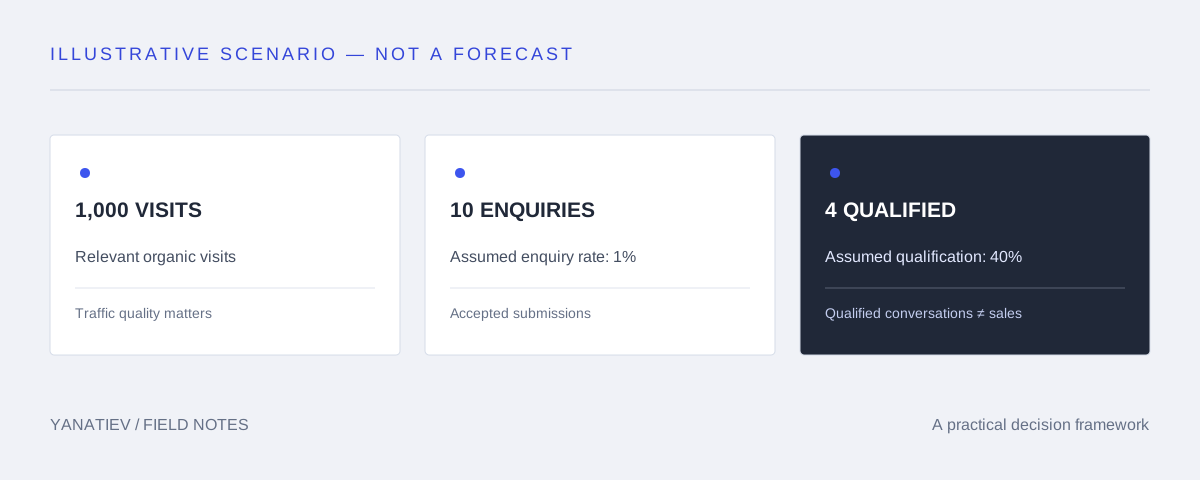
Use scenarios instead of a single promised return
Here is a purely illustrative scenario: 1,000 relevant monthly organic visits, a 1% enquiry rate and a 40% qualification rate would produce 10 enquiries and 4 qualified conversations. At a 0.3% enquiry rate, the same traffic produces 3 enquiries. Neither rate is a benchmark or forecast for this website.
The arithmetic is useful because it exposes the assumptions. Traffic quality, offer fit, the buying cycle and attribution all matter. A thousand visits to unrelated tutorials may contribute less pipeline than a smaller number of visits to a well-matched service page.
Keep sales outcomes separate from marketing events. An accepted form submission is not automatically a qualified opportunity, and an opportunity is not revenue. Use your own sales data before assigning a monetary value.
Choose a delivery model that matches your team
If you have capable writers and developers, consulting may focus on direction and review. If you lack those resources, budget for execution as well. A one-off audit can be useful for a defined diagnostic problem; ongoing support can help a team make and evaluate successive changes.
Use the consultant scorecard to compare ownership and evidence. A proposal should make scope and exclusions clear enough that two options can be compared on the same basis.
Set review points around decisions
At the first review, confirm that the agreed work exists and that the implementation is correct. Later, examine discovery and query relevance. Then review whether visitors reach an appropriate next step and whether enquiries fit your target customer.
Do not use a fixed short deadline to declare that every page has succeeded or failed. Search outcomes depend on discovery, competition and execution. Equally, do not keep funding a plan that produces no usable deliverables or refuses to explain its assumptions.
Know when to redirect the budget
If pages are not being indexed, investigate the reason before adding more pages. If impressions grow but clicks do not, review intent and the search result presentation. If relevant visits grow but enquiries do not, review the offer, proof and contact path. If enquiries are poor fit, revisit the audience and topic selection.
Each finding suggests a different allocation. The budget should support the next useful experiment, with a named owner and an observation period, rather than automatically purchasing the same number of articles.
Prepare a brief for a meaningful quote
- Your product or priority services and target markets.
- The current website and available analytics baseline.
- Your main business problem and definition of a qualified enquiry.
- Writing, expert-review and development capacity.
- Known constraints and the scope you want priced.
You do not need perfect data before speaking to a consultant. You do need a shared understanding of what is known, what is uncertain and who can act on the findings.
PLAN THE WORK
Get a scope that fits your team's capacity.
Explore SaaS SEO consulting or B2B content strategy, then share your priorities.